Have a PCI DSS pentest performed

We test like an attacker attacks and report like a QSA reads. This way, every vulnerability becomes evidence for your PCI DSS assessment. We are only satisfied when your cardholder data is demonstrably secure, even for your assessor.

PCI DSS pentest

PCI DSS pentest: evidence for requirement 11.4 and your QSA

Experienced ethical hackers test your cardholder data environment inside and out and verify your segmentation. We link every finding to the requirements of PCI DSS v4.0.1, so your QSA can use the report directly for the assessment.

Schedule a no-obligation consultationDownload Buyer’s Guide

Retest standard included·Reporting within 5 working days·According to the CCV certification mark

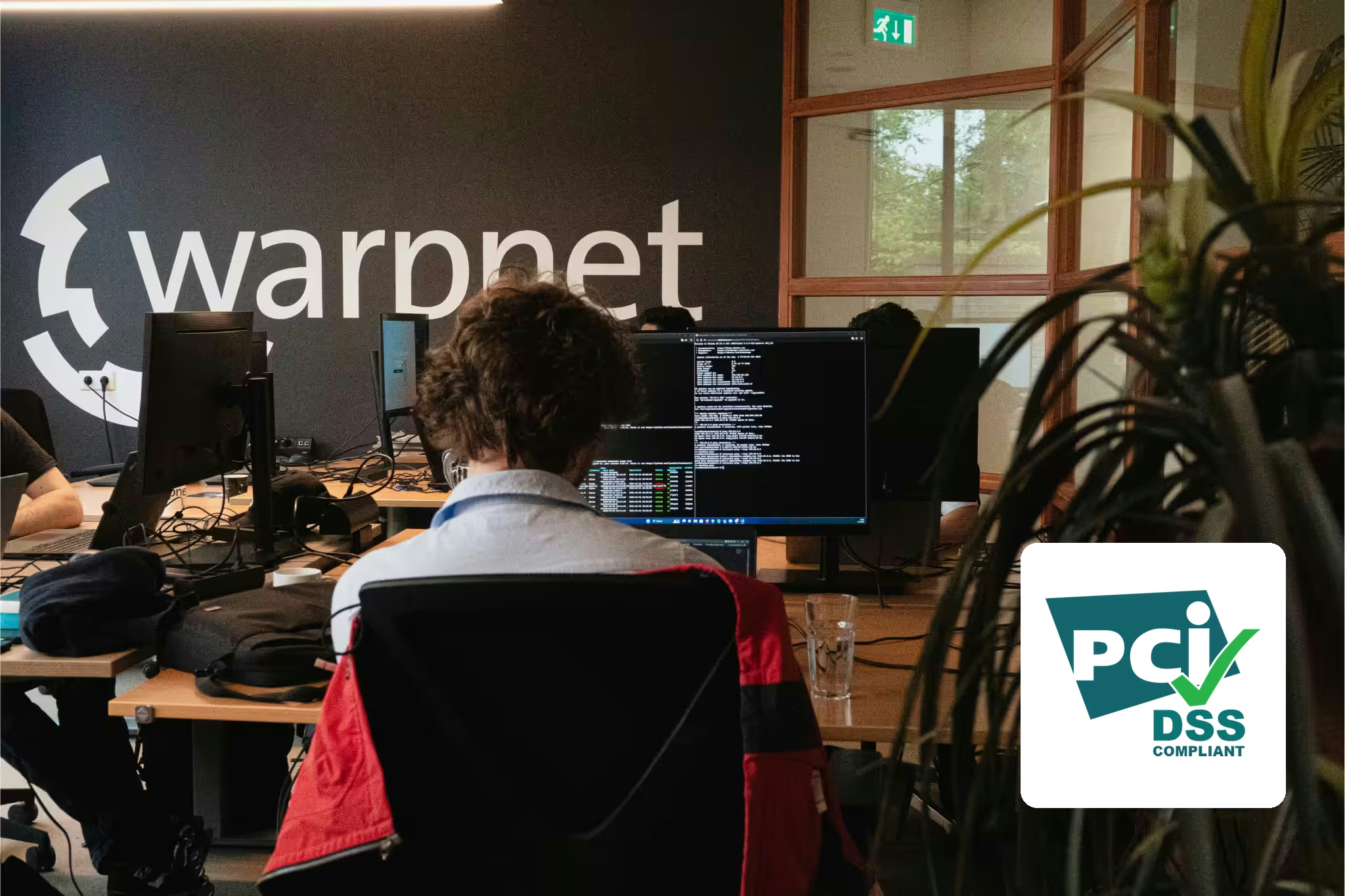
CCV-gecertificeerde pentester van Warpnet aan het werk aan een PCI DSS pentest

SOME OF OUR CLIENTS

N8nYdenticNieuw WoelwijckRijksoverheidEffectoryVentolinesPatchmanager
Warpnet PCI DSS pentest illustratie

How does a PCI DSS pentest by Warpnet work?

Every specialist can record risks. Fix them? That is our specialty.

  1. We work with you to determine the scope, target environment and desired results of the pentest.
  1. We collect data about the target using public sources (this is known as OSINT).
  1. We scan for recent and current vulnerabilities using
    AI scanners and manual inspection.
  1. Our ethical hackers exploit vulnerabilities, which allows them to gain access to systems and data.
  1. You will receive a detailed report in which we explain all vulnerabilities along with next steps.

How Warpnet one step further is going

  1. We support you in remedying the risks identified during the test by offering technical insight and advice.
  1. After the recommendations have been applied, we will perform a retest, which
    ensures that the vulnerabilities have truly been resolved.
35+
Driven specialists
750+
Happy customers
5.000+
Assessments carried out
100.000+
Vulnerabilities discovered

Why Warpnet for PCI DSS pentesting?

CharacteristicWarpnetOther parties
ApproachCustomization combined with advanced AI toolsAutomatic scans, exploit attempts
RetestIncluded, as required by requirement 11.4.4Not included or available at an additional cost
MethodologyDocumented per requirement 11.4.1, NIST and OWASPAn often superficial checklist
ReportingAudit-ready and mapped to PCI DSS requirementsTechnical report without context
Presentation of EvidenceScreenshots, CLI output, and attack scenariosOutput from automatic scanners
SupportGuidance during recovery and with questions from your QSAThe process ends with the PDF report

Certifications & methodologies

CCVOSCPOSSTMMPTESOWASPMeow

Penetration test types for environments such as:

Web application pentest

  • Realistic attack scenarios exposing vulnerabilities from the OWASP Top 10, CWE, and SANS Top 25, including in checkout and payment pages
  • Fixes are quickly validated using clear proofs of concept (PoCs) for developers and a retest
  • Audit-ready for PCI DSS, ISO 27001, SOC 2, and the GDPR; conducted in accordance with NIST SP 800-115

Mobile application pen test

  • iOS and Android apps with payment functionality tested for insecure storage, API abuse, and app logic flaws
  • Specific remedial steps to better protect sensitive user data
  • Following the OWASP Mobile Top 10, PTES, CVSS, and PCI DSS

API Penetration Test

  • Shadow and zombie APIs mapped to prevent data leaks and unauthorized access
  • Authenticated, manual testing of REST, SOAP, and GraphQL APIs and the connections with your payment provider
  • Following the OWASP API Security Top 10, PCI DSS, SOC 2, and the GDPR

Cloud pentest

  • AWS, Azure and GCP environments processing map data assessed for misconfigurations, privilege escalation and exposed services
  • Step-by-step recovery plan for a demonstrably secure cloud environment
  • In alignment with the OWASP Kubernetes Top 10, CIS Benchmarks, NIST, PCI DSS, ISO 27001, and SOC 2

Network pentest

  • On-premises and hybrid networks tested for CDE segmentation, misconfigurations, lateral movement, and privilege escalation
  • Risk-prioritized recommendations that IT and security teams can get started with immediately
  • Standards: NIST SP 800-115, PTES, CIS Controls, PCI DSS and ISO 27001

AI and LLM pentest

  • Vulnerabilities in AI applications, chatbots, and LLM pipelines exposed
  • Tested for, among other things, prompt injection, model manipulation, data leaks, and multi-stage exploit chains
  • Threat modeling and concrete remediation advice, aligned with ISO/IEC 42001, the EU AI Act, SOC 2, and the GDPR

Pentest services for industries such as:

Fintech

  • Payment platforms and financial systems tested for business logic flaws and transaction abuse
  • Concrete fixes and demonstrable compliance with PCI DSS, DORA, ISO 27001, and SOC 2
  • Standards: OWASP, PTES, CVSS

E-commerce & Retail

  • Webshops, checkouts and payment pages secured against BOLA/IDOR risks and skimming scripts (requirement 6.4.3)
  • Supporting developers with guided remediation and compliance for PCI DSS, ISO 27001, and SOC 2
  • Standards: OWASP, PTES, CVSS

HoReCa, travel & ticketing

  • Booking and reservation systems, point of sale (POS) systems, and guest networks tested for cardholder data access
  • Segmentation test proving that guest and office networks are separated from the CDE
  • Standards: OWASP, PTES, NIST SP 800-115

SaaS & Technology

  • Pentests per release or at fixed times, so that your platform complies with requirement 11.4 all year round
  • Semiannual segmentation test for service providers (requirement 11.4.6) and evidence for the AOC that your customers request from you
  • Standards: OWASP, PTES, CVSS, NIST SP 800-115

Not only suitable for PCI DSS, but also:

AVGISO 27001DigiDBIODORANIS2NEN 7510

Success story: Patchmanager

Developers of cable and asset management solutions

2024

Start of the collaboration

3

Black box pentests as a starting point

24/7

Monitoring by the Warpnet SOC

The challenge

Right in the middle of the process toward ISO 27001 certification, Patchmanager wanted to structurally strengthen the digital resilience of both the organization's internal network and the product — with regular, in-depth pentests as the foundation.

The Approach

The collaboration began with three black-box penetration tests and, as trust grew, expanded to include gray-box and white-box testing. During the white-box test, Warpnet was granted full access to the architecture, source code, and accounts to identify risks.

The outcome

Each test delivered a clear, risk-based report that allowed Patchmanager to get to work immediately. The collaboration evolved into 24/7 SOC services featuring continuous monitoring, response, and the complete remediation of risks and incidents.

“We are very happy with the collaboration with Warpnet. The team has in-depth expertise and truly looks at how they can help us. They communicate well, are flexible, and always do more than they are supposed to do.”

Jerry SeagerJerry Seager
CTO, Patch Manager

Trusted by 750+ CTOs and CISOs

Marco Vellinga

Spindle

“The team was very helpful and met every deadline. They went above and beyond by expanding the scope of the test to address unexpected issues—even though they were not obligated to do so. A truly reliable and pleasant team to work with.”

Erik Rademaker

Envitron

“Warpnet approached the task very seriously and pulled out all the stops to make the test as realistic as possible. Through observation, they discovered how they could gain alternative access to our premises. In the course of this, they succeeded in placing a listening device on the network..

Jasper Zondervan

New Woelwijck

“Warpnet's pen test provided us with a clear picture of the bottlenecks in our security so that we could improve it further. We immediately fixed the high-risk points in the week that followed. So we know that our residents and staff can live and work safely and that we comply with NEN 7510.”


Noud Huisman

Enshore

“Without Warpnet, we would estimate needing at least two additional employees, and that would only be staff who can determine what needs to be resolved – without even addressing the actual fixing of problems.”

Certifications & Accreditations

Contact us

You will hear from one of our experts within one business day.

Het team van Warpnet

Contact form

Name(Required)

Frequently Asked Questions

PCI DSS pentest FAQs

Is a retest included?

Yes. PCI DSS requires that exploitable vulnerabilities are remediated and retested (Requirement 11.4.4). After your team implements the recommendations, we will perform the retest and document the result in the report so your QSA can verify the remediation.

How often does PCI DSS require a pentest?

At least once every twelve months an internal (requirement 11.4.2) and an external pentest (requirement 11.4.3), and again after any significant change in infrastructure or applications. If you use segmentation to limit the scope of your cardholder data environment, you test that segmentation annually (requirement 11.4.5). For service providers, this applies every six months (requirement 11.4.6).

Must the pentester be a QSA or ASV?

No. PCI DSS requires that the pentest is performed by a qualified internal employee or external party who is organizationally independent from the management of the tested systems. A QSA or ASV registration is not required for this. Our CCV-certified ethical hackers meet this requirement and deliver the report that your QSA uses for the assessment.

What does a PCI DSS pentest from Warpnet cost?

After a no-obligation intake, you will receive a quote, and that is the price you pay. The price depends on the size of your cardholder data environment, the number of segments, and whether you need an internal, external, or combined test. Reporting, explanation, and a retest are included as standard. Below you will find general price indications for a one-time pentest and Pentesting as a Service (continuous pentesting).

One-time pentestVAT: €3,200
Pentesting as a Service: i.e. €1,250 per month

Packages & Pricing

What is the difference between an ASV scan and a pentest?

An ASV scan is an automated external vulnerability scan that you must have performed every quarter by an Approved Scanning Vendor (requirement 11.3.2). A pentest is manual and deeper: our specialists validate findings, combine them into realistic attack chains, and also test the business logic of your applications and the effectiveness of your segmentation. PCI DSS requires both. One does not replace the other.

Which systems fall within the scope of a PCI DSS pentest?

The cardholder data environment (CDE): all systems that store, process, or transmit card data, plus the systems connected to it or that can affect its security. The pentest covers the entire perimeter of the CDE and critical systems, from both inside and outside the network, at the network and application level. During the intake, we will review your scope and segmentation with you, ensuring you do not test too little and do not pay for too much.