Web Application Pentest
Discover and fix vulnerabilities in your web application(s) with a pen test from Warpnet.
Discover and fix vulnerabilities in your web application(s) with a pen test from Warpnet.
Web Application Pentest
Both in cybersecurity and in life, our own weaknesses are the hardest to pinpoint. Fortunately, we have no problem capturing the risks in your security. In fact, we don't actually do anything else. And that's a good thing: Knowing where your vulnerabilities lie - and the ways attackers can exploit them - is one of the most valuable insights you can gain for improving your security strategy. By conducting a pen test, we help you achieve several common objectives, such as:
"I want to know where the risks in our Web application(s) are hiding."
"I think our security is working well, but I want more assurance."
"I want to become compliant with a certain legislation/standards framework."

SOME OF OUR CLIENTS






Most cybersecurity parties consider a pentest to be complete as soon as the report is delivered. Warpnet thinks differently - We are not satisfied until your security is demonstrably in order. With this goal in mind, we will guide you in remedying the risks we identify for you.
This makes Warpnet the only pentest specialist in the Netherlands with an approach through which you'll get more than insight. It is our mission to ensure that your security is truly resilient to advanced attacks. We therefore support you from start to finish of the test, and after.
Want to spar with an expert?

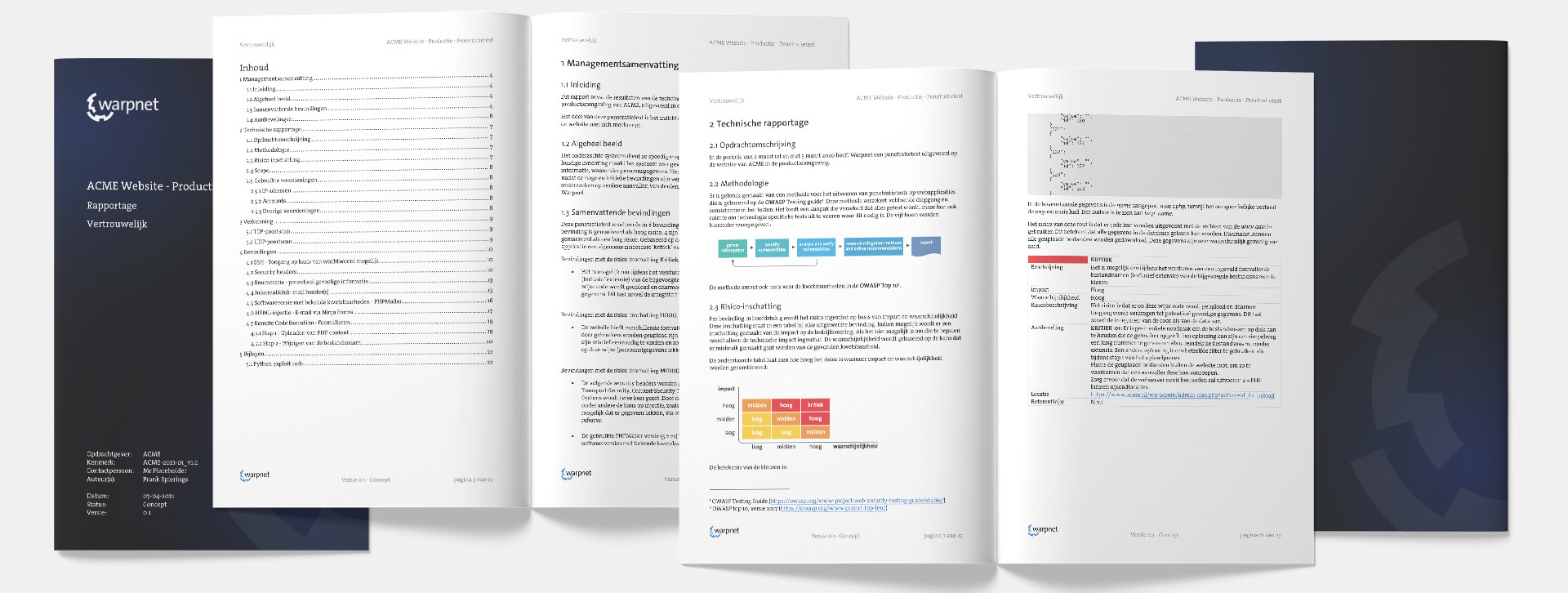
The findings are recorded in a final report, which includes a comprehensive and manageable management summary. The identified vulnerabilities are reviewed and supplemented with recommendations and improvement actions, and are prioritized based on the risk associated with them. In addition, we provide recommendations for future security measures.

A a total lack of information pentest assumes a total lack of information about the target; the testers are unfamiliar with the structure and users of the target environment.

With a Grey Box pentest, the team receives limited information about the target. Consider, for example, technologies used and authorised user accounts.

In the case of a White Box pentest, detailed information is provided about the target environment. This includes the target's source code, accounts, architecture, and more.
What is a pentest?
A pen test (or penetration test) is a security test in which a cybersecurity expert attempts to find and exploit vulnerabilities in a computer system. The purpose of this simulated attack is to identify weaknesses in a system's defenses that attackers could exploit.
This is like a bank hiring someone to dress up as a burglar and try to break into their building and gain access to the vault. If the ‘burglar’ succeeds and penetrates the bank or the vault, the bank gets valuable information on how to tighten their security measures.
What are the benefits of a pentest?
A pentest is a crucial part of network security. Through these tests, an organisation discovers:
Through pentesting, security professionals can effectively find and test the security of multi-tier network architectures, custom applications, web services and other IT components. These pentesting tools and services help you quickly understand the areas of highest risk, allowing you to effectively plan security budgets and projects.
Thorough testing of a company's entire IT infrastructure is necessary to take the precautions needed to secure vital data from hackers while improving an IT department's response time in the event of an attack.
What does a pentest cost?
The cost of a pentest varies and depends on your objectives: the systems and/or networks to be analysed, the complexity of the test, and the methodology used (black box, grey box or white box).
Warpnet does not utilise an ‘out-of-the-box’ approach when performing a pentest; all assignments we perform are customised, which means there is no standard rate.
How long does a pentest take?
A Warpnet pentest takes 4 days on average, although the duration may vary based on the scope and objectives of the pentest.
The corresponding report is delivered by default one week after the completion of the pentest.
Is a one-time pentest sufficient?
In short, no.
This is because a pentest is always a snapshot in time. Both the attacks and the infrastructure or application being tested evolve, so the results of a test become less relevant over time.
Who should have a pentest carried out?
Ideally, everyone. Cybercrime has expanded to the point where even small businesses can no longer consider themselves too small for an attack.
As we have seen in recent large-scale attacks, such as the WannaCry ransomware outbreak, everyone is at risk.
Can a pentest cause damage?
No. Our pentest specialists know how to securely penetrate applications and networks without causing actual damage or disruption.
Moreover, we have rock-solid guarantees so that all data we access is handled with the utmost confidence and security.
How much of a test is automated?
A question too few people ask is how much of testing is automated versus manual.
Although automated tools are a short step at the beginning of our process, much of our testing is manual. The amount of manual work varies from assignment to assignment, but about 95% of pentest is hands-on.
How does a pentest support compliance goals?
Pentests play an important role in helping organisations meet compliance and regulatory requirements by proactively detecting vulnerabilities so that they can then be remedied.
Regulatory frameworks such as the General Data Protection Regulation (GDPR), and various security standards such as ISO 27001 require organisations to implement robust security measures to protect sensitive data.
Pentesting demonstrates an organisation's commitment to maintaining a secure environment, reducing the risk of breaches and resulting fines.
Where can most vulnerabilities be found?
There is no single answer to this question because vulnerabilities can exist anywhere in the organisation: main websites, core systems, remote access systems, mobile apps and management systems. It is true that many ‘low-hanging fruit’ vulnerabilities exist in overlooked corners of an organisation; an old test environment, for example, tends to have old and outdated frameworks.
It does not matter to the attacker that the system is not in use or forgotten, as long as he can exploit it and turn it into an access point to the organisation's internal network.
An organisation should always be aware of its vulnerabilities by regularly carrying out pentests on every system and the entire network.
What happens after the pentest is done?
To facilitate the recovery process, pentests should be evaluated to ensure they provide actionable guidelines for tangible security improvements.
After each assignment, the ethical hacker assigned to the test must prepare a customised written report detailing and assessing the risks of the identified weaknesses and recommending remedial actions.
A supplier may also offer a comprehensive debriefing after submitting the report.
Does Warpnet help solve found risks?
Fixing the identified vulnerabilities is often a complex process because of the specialist skills required to do so.
As part of our after-care support, we therefore offer assistance in repairing the identified vulnerabilities. During this process, we educate your team on various cybersecurity best practices at no extra cost.
Is it wise to share the results of a pentest?
It is not a good idea to send results outside your organisation; a pentest report contains highly sensitive information that is highly confidential and should only be made available to trusted internal sources on a need-to-know basis. Sharing detailed reports with external people is not recommended.
Once the report is shared with an external party, control over its dissemination is difficult to ensure. A pentest report can be a roadmap to an organisation's vulnerabilities and should not be distributed outside the organisation unless absolutely necessary.
How is a pentest different from a vulnerability scan?
Pentesting and vulnerability scanning are both designed to detect vulnerabilities and other security problems. However, they differ considerably in terms of technique and the types of problems they can detect.
Unlike a pentest, vulnerability scanning is performed entirely using automated tools. These tools contain databases of signatures of known attacks such as CVEs and vulnerabilities included in the OWASP Top Ten list. The tool assesses whether the target systems may contain these vulnerabilities and generates an automated report describing all discovered vulnerabilities and their severity.
Pentesting provides deeper insight into an organisation's vulnerabilities than a vulnerability scan. While vulnerability scanning identifies security problems in an organisation's attack surface, pentesting consists of exploiting and combining these vulnerabilities to gain deeper access.
Vulnerability scanning is often part of a pentest, identifying low-hanging fruit and potential places where a pentester can begin their assessment. However, a pentest goes deeper, providing a better understanding of the impact of different vulnerabilities and helping to eliminate false-positive detections.
Want to know more? We would be happy to help you.

Jeff Schaafsma
Cybersecurity Advisor